Tax Strategies When Selling a Business

Before You Sell Your Business, Understand What You May Actually Keep

Before You Sell Your Business, Understand What You May Actually Keep

You've spent years - perhaps decades - building your company. When it's time to sell, the headline purchase price is only part of the equation. What matters is what you keep after taxes.

The structure of a business sale can affect how much of the purchase price is subject to capital gains tax, ordinary income tax, depreciation recapture and state income tax - and when those taxes become due.

Do not wait until closing to start tax planning. 

How Much Tax Will I Pay When I Sell My Business?

  • Entity type
  • Stock versus asset sale
  • Owner tax basis
  • Allocation of purchase price
  • Amount attributable to goodwill
  • Depreciated assets
  • Inventory and receivables
  • Seller financing
  • Installment payments
  • State of residence
  • States in which the business operates
  • Prior tax elections
  • Transaction expenses
  • Ownership structure

A $20 million sale does not necessarily create the same tax result for two different $20 million businesses. Tax planning should begin with a transaction-specific analysis

Stock Sale vs. Asset Sale: Why It Matters

Stock Sale
In a stock sale, the shareholder generally sells ownership interests in the company. From the seller's perspective, qualifying gain on stock may generally receive capital-gain treatment, subject to basis and other applicable rules.

Asset Sale
In an asset sale, the company sells individual business assets. Different portions of the purchase price can receive different tax treatment, including capital gain, ordinary income, depreciation recapture, goodwill, inventory income and other categories.

How Is Goodwill Taxed When Selling a Business?

For many privately held companies, a substantial portion of enterprise value may be attributable to goodwill. Tax treatment depends upon the transaction and ownership of the goodwill. Determining whether value is attributable to corporate goodwill, personal goodwill or other intangible assets requires careful legal, valuation and tax analysis.

Seven Strategy Areas to Evaluate

1. Installment Sale
May allow eligible gain to be recognized as principal payments are received rather than entirely in the year of sale. Consider buyer credit risk and items that do not qualify for installment treatment.

2. Deferred Sales Trust
Generally structured around federal installment-sale rules and requires careful pre-sale planning, independent parties and tax/legal analysis.

3. Charitable Planning Before the Sale
For owners with genuine philanthropic goals, charitable remainder trusts, donor-advised funds or other structures may warrant evaluation before the sale.

4. Qualified Opportunity Zone Planning
Availability and benefits depend on current law, timing and the nature of gain. Evaluate under the rules in effect at the time.

5. Estate Planning Before the Sale
Gifts, trusts, family entities, charitable planning, insurance and wealth-transfer strategies may need to be considered before value is converted to liquid proceeds.

6. State Residency & State Tax Planning
Domicile, residency, sourcing, entity type, business operations and timing can all matter. A change of address alone does not necessarily eliminate state tax.

7. Business Valuation Before the Sale
Understanding enterprise value, value drivers, weaknesses, owner dependence, customer concentration, management strength and goodwill can improve both exit and tax planning.

Book A Complimentary Consultation

Entity-Specific Considerations

Selling an S Corporation
Stock vs. asset structure, shareholder basis, asset basis, goodwill, depreciation recapture, purchase-price allocation, state taxation, prior C corporation history and transaction elections may matter.

Selling a C Corporation
An asset sale followed by distribution can potentially create corporate- and shareholder-level tax. A stock sale may produce a different result.

Selling an LLC or Partnership
Taxation depends in part on entity classification and what is sold. Purchase-price allocation, receivables, inventory and depreciation can affect character of gain.

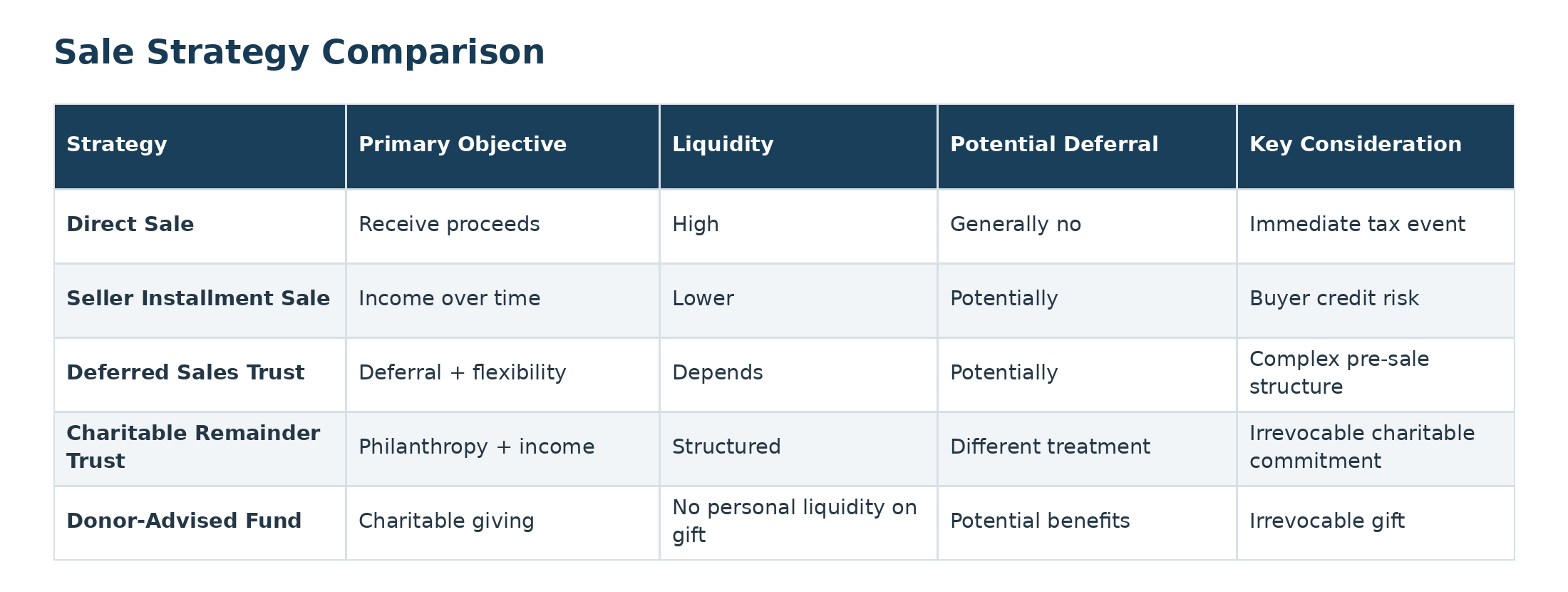
Compare Business Sale Tax Strategies

The Business Sale Tax Planning Timeline

12-24+ Months Before Sale
• Business valuation
• Value enhancement
• Entity and ownership structure
• Estate planning
• Charitable objectives
• State residency
• Management succession
• Financial independence analysis
• Tax modeling

6-12 Months Before Sale
• Stock vs. asset sale
• Purchase-price allocation
• Capital gains strategies
• Installment alternatives
• Deferred Sales Trust
• Charitable structures
• Estate transfers
• Post-sale income needs

Before Signing the LOI or Definitive Agreement
• Bring tax attorney, CPA and planning team into the transaction
• Identify strategies that must be established before rights to proceeds become fixed before Closing
• Confirm transaction structure and tax projections
• Complete required entities/trusts/intermediaries and documentation
• Plan post-sale cash flow and estimated taxes

After Closing
• Investment management
• Tax reporting
• Estate planning
• Wealth preservation
• Income planning
• Family wealth transfer
• Charitable objectives

Questions to Ask Before Selling Your Business

  1. What is my estimated federal and state tax liability?
  2. Is this expected to be a stock sale or asset sale?
  3. How will the purchase price be allocated?
  4. How much value is attributable to goodwill?
  5. Which portions may receive capital-gain versus ordinary-income treatment?
  6. Do I need all sale proceeds immediately?
  7. Would an installment structure meet my objectives?
  8. Should I evaluate a Deferred Sales Trust?
  9. Do I have meaningful charitable objectives?
  10. Should estate planning occur before the sale?
  11. Does my state of residence affect the transaction?
  12. How much after-tax income will I need after I sell?
  13. What return will my remaining capital need to generate?
  14. Have my CPA and tax attorney reviewed the proposed structure?
  15. What planning opportunities disappear once I sign?
Book A Complimentary Consultation

Business Sale Tax Planning FAQs

How can I reduce taxes when selling my business?
Potential strategies may include negotiating sale structure and allocation, installment planning, charitable planning, estate planning and other pre-sale strategies.

Is selling a business taxed as a capital gain?
Not necessarily in its entirety. Entity structure, stock vs. asset treatment, goodwill, depreciation recapture, inventory and other factors can affect the result.

How is goodwill taxed?
Treatment depends on the transaction and nature and ownership of goodwill; transaction-specific analysis is required.

Can I defer capital gains tax?
Potentially. An eligible installment sale or other properly structured pre-sale strategy may defer recognition of certain gain.

Can I use a 1031 Exchange when selling my company?
A 1031 Exchange generally applies to qualifying real property rather than the operating business itself.

How early should I begin?
Ideally well before a sale is imminent; some strategies benefit from substantial lead time.

What happens if I wait until after closing?
Many pre-sale strategies are no longer available once a completed sale and receipt of proceeds have occurred.

BEFORE YOU SIGN THE LOI, KNOW YOUR OPTIONS. A successful exit requires understanding what you will receive, what you may owe, what you may keep, and whether what remains can support the life and legacy you want after the business.


Work With Noble Wealth Solutions

With over 30 years of experience in business and estate planning, Ben Levine is a leading expert in executive benefit planning and tax-advantaged strategies. As a Principal at First Financial Resources (FFR), Ben provides access to exclusive financial structures designed specifically for high-income business owners and professionals.

If you're ready to reduce taxes, build wealth, and secure your financial future, let’s start the conversation.

Schedule a Call